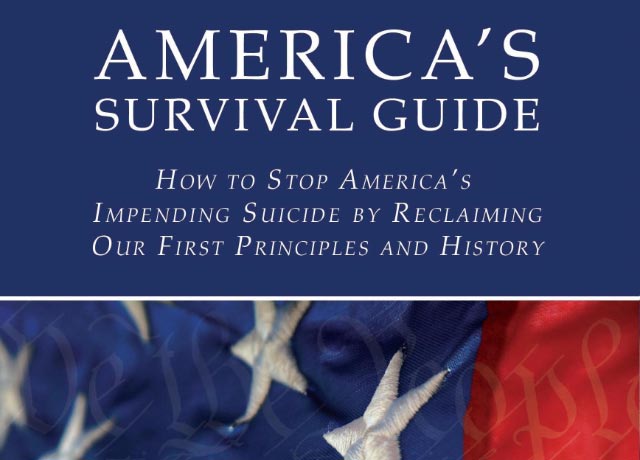
Friday, April 16, 2010

Unalienable Rights - Endowed by the Creator not by Government

As Thomas Jefferson explained, “a free people claims their rights as derived from the laws of nature, and not as a gift from their chief magistrate.”  This understanding is deeply rooted in the American experience.  We understand that "all men are created equal, that they are endowed by their Creator from unalienable rights . . . ."

This understanding rejects the idea that we depend upon the government for our rights.  Yet, this belief seems to be too often forgotten today. Many act as if everything we desire, everything we need, must come with the approval of the government.  This subverts the American principle - in America the government serves the people, not the other way around.

As we move forward with new policies, we need to keep in the forefront that the people are sovereign, and do not require the government to bless their liberties.  Indeed, our liberties are blessings - from nature and the Creator.

Thursday, April 8, 2010

The People's Constitution

Daniel Webster famously explained in his Second Reply to Hayne that "It is, sir, the people's Constitution, the people's government, made for the people, made by the people, and answerable to the people."

This idea underlies the First Principle of the Social Compact - articulated in our Declaration of Independence "that governments are instituted among men, deriving their just powers from the consent of the government."

The growing frustration and resentment of the public - on all sides of the political spectrum - with government today often stems from the belief that government of the people has been subverted to the interest of the government of the special interest.  The pitching of factions against one another has always been a feature of our republic, but the domination of special interests in so many political avenues threatens the legitimacy of our system.  With so many political discussions devolving into rancor and personal attacks, that many have become cynics is not surprising.

So what do we do?  Become educated, become more engaged in the political process, and hold our leaders accountable for their actions.  To do otherwise cedes the field to the most corrupting influences in our politics.

Wednesday, April 7, 2010

Freedom is Lost By Gradual and Silent Encroachments

James Madison warned that "Since the general civilization of mankind, I believe that there are more instances of the abridgment of the freedom of the people by gradual and silent encroachments of those in power, than by violent and sudden usurpations . . . ."  Stated another way, we don't simply lose our freedom by coups and martial law - our liberties can be suffocated by small measures, which over the course of time, strangle our liberty.

We need to be vigilant to protect our liberties, and the only way we can expect to keep our freedom is if we are well educated in connection with our Constitution and the First Principles that undergird it.  Take some time away from American Idol and Tiger Woods, and spend some more about learning about our Constitution and First Principles.  Then, and only then, can we halt the otherwise "gradual" and "silent" affronts to our liberty.

Thursday, April 1, 2010

Things Fall Apart; the Centre Cannot Hold . . .

"Things fall apart; the centre cannot hold;
Mere anarchy is loosed upon the world,
The blood-dimmed tide is is loosed, and everywhere
The ceremony of innocence is drowned;
The best lack all conviction, while the worst
Are full of passionate intensity."  -- William Butler Yeats 


Today, it seems that we are in world full of passionate intensity from quarters who care little for our First Principles and Constitution.  This punishing wave only displaces those who try to marshal their forces in favor of liberty and freedom.  We cannot let Yeats come to fruition.  Form the centre - and hold it fast.

Monday, March 29, 2010

Hold Firm To Preserve Liberty - Even in the Face of Good

George Washington stated, "let there be no change [in Constitutional powers] by usurpation; for though this, in one instance, may be the instrument of good, it is the customary weapon by which free governments are destroyed."  


Washington well understood that often the liberties of the people are destroyed not by those trying to do evil, but by those try to do good.  In other words, in the hope of achieving a desired policy end, politicians have often skirted the law, ignored precedent and tradition, and otherwise undermined constitutional limitations.  When this happens, the law is corrupted, and liberties of the people are no longer safe.  


Simply put, the power to do good, is the power to do evil.  Once constitutional limitations are shattered in the pursuit of a "good policy", those same limitations become irrelevant to stop "bad" policies.  This is a most common path to the subversion and ruin of free peoples.  Thus, we must stand firm to protect the Constitution - even in the face of the good.

Thursday, March 25, 2010

Iraq Stands Up for Liberty

Less than two weeks ago, millions of Iraqi citizens stood up for liberty by voting in the parliamentary elections, in the face of militants who attempted to foil freedom by disrupting elections.

Perhaps our citizens at home could take a lesson from those who braved threats and intimidation to vote.  Although this year has generated a great deal of heat and controversy, traditionally Americans have been less engaged as is healthy for our republic.

If our celebrity obsessed media would have spent as much time on the Iraqi election as they did Tiger Woods, we would have all benefited. Still, we can take a cue from Iraq and find the determination to be thoughtfully engaged in the political process.

If not, we get the government we deserve.

Thursday, March 18, 2010

Remember Limited Government

A fundamental First Principle of our Declaration of Independence, and embedded in our Constitution, is a limited federal government.  Having just beaten back British tyranny, and fearful of a centralized, overbearing and uncontrolled government, the Founding Fathers determined to give the federal government specific, enumerated powers in the Constitution.  


The idea of limited government is articulated in the Declaration of Independence's explanation that "that to secure these [unalienable rights], governments are instituted among men, deriving their just powers from the consent of the governed."  It is specifically confirmed in how the Constitution was drafted - Article I specifically enumerates the powers vested in the federal government.  To eliminate any doubt, the 9th and 10th Amendments expressly provide that any powers not specifically granted to the federal government are reserved to the States or the people.


Today, however, the idea of limited government is mostly ignored.  There is very little discussion on most issues regarding whether it is appropriate for the federal government to act.  Although the health care debate has raised serious concerns about the appropriate scope of the federal government, most policy discussions involving a whole range of issues revolves around how the federal government should address a particular issue.  


Thomas Jefferson wrote, "The construction applied ... to those parts of the Constitution of the United States which delegate Congress a power ... ought not to be construed as themselves to give unlimited powers, nor a part to be so taken as to destroy the whole residue of that instrument."  His counsel is mostly ignored.  


When a proposal for federal intervention is made, the very first question that should be asked is whether it fits within the powers given to the federal government.  To ignore that question only guarantees the subversion of our Constitution.